

On May 18, International Museum Day, the Evictions Museum, in Vila Autódromo, in Rio de Janeiro’s West Zone, marked nine years of (re)existence. The date was celebrated with the relaunch of its walking tour, an event held as part of the 23rd National Museum Week, promoted by the Brazilian Institute of Museums, from May 12 to 18. Throughout the week, the Evictions Museum and other museums across Brazil organized events themed “The Future of Museums in Rapidly Changing Communities.”
Originally launched on May 18, 2016, the Evictions Museum is a community museum founded by residents and supporters of Vila Autódromo, an established community that was violently evicted using inconsistent reasoning by the City of Rio de Janeiro in the lead up to the 2016 Olympics.
From Fishing Community to Olympic Park: A History of Resistance to Real Estate Speculation
Vila Autódromo emerged in the 1960s as a fishing community that settled in the Itapeba Peninsula, on the shores of the Jacarepaguá Lagoon. The community expanded with the arrival of families working on the nearby racetrack construction, and the urban occupation of Barra da Tijuca. In 1989, Vila Autódromo welcomed families from the Cardoso Fontes favela, relocated by the State of Rio de Janeiro. In 1994, it took in 60 more families relocated by the state, through the Municipal Secretariat of Housing and Land Affairs (SEHAF).
It was during this period, in 1993, that City Hall made its first eviction threat towards Vila Autódromo, based on accusations that the community was responsible for aesthetic and environmental harm to its surroundings. Over the course of 30 years, many threats of and attempts at forced eviction were made. Then, in the wake of the 2016 Olympics, the forced eviction process was finally carried out by City Hall.
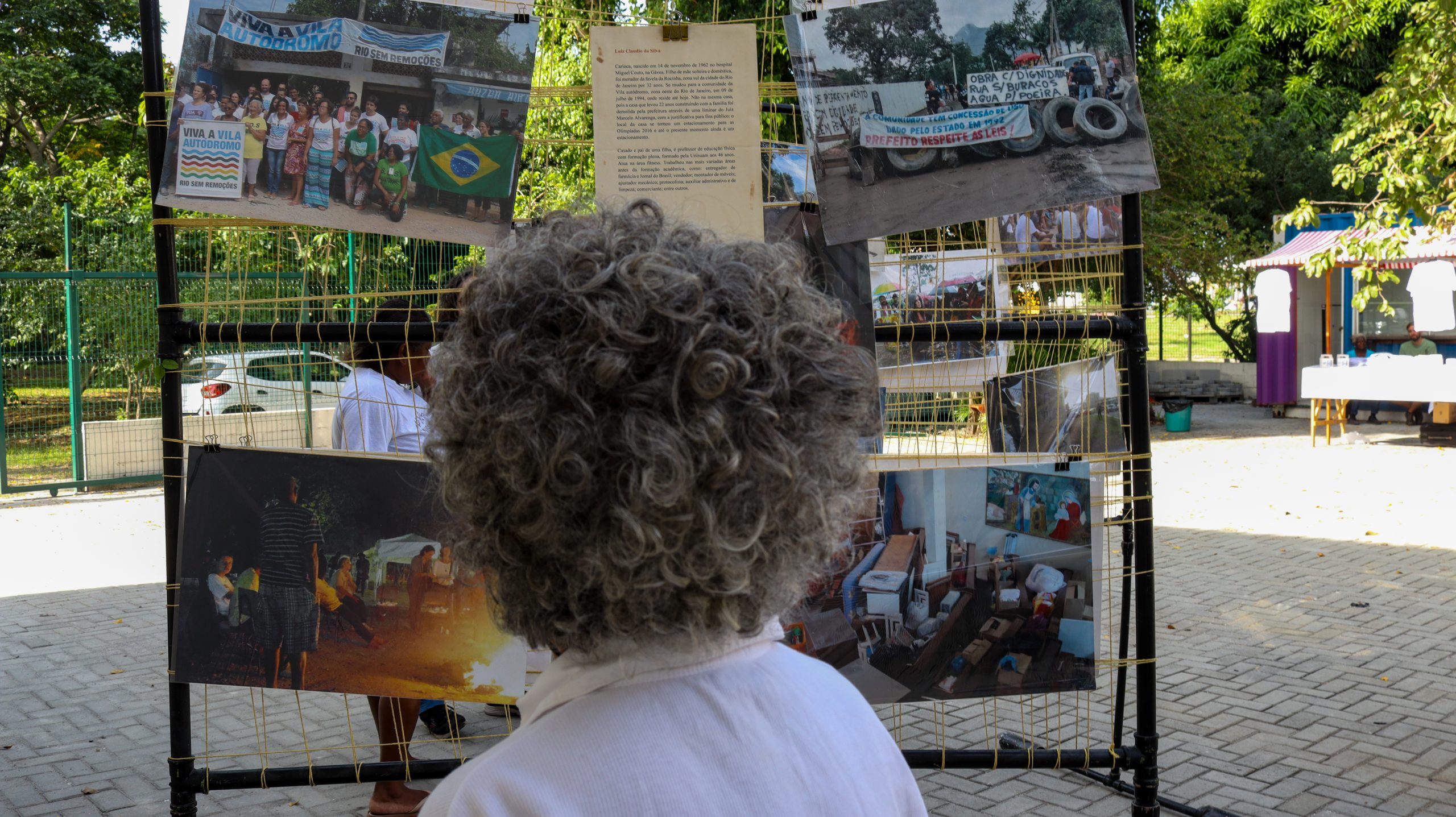
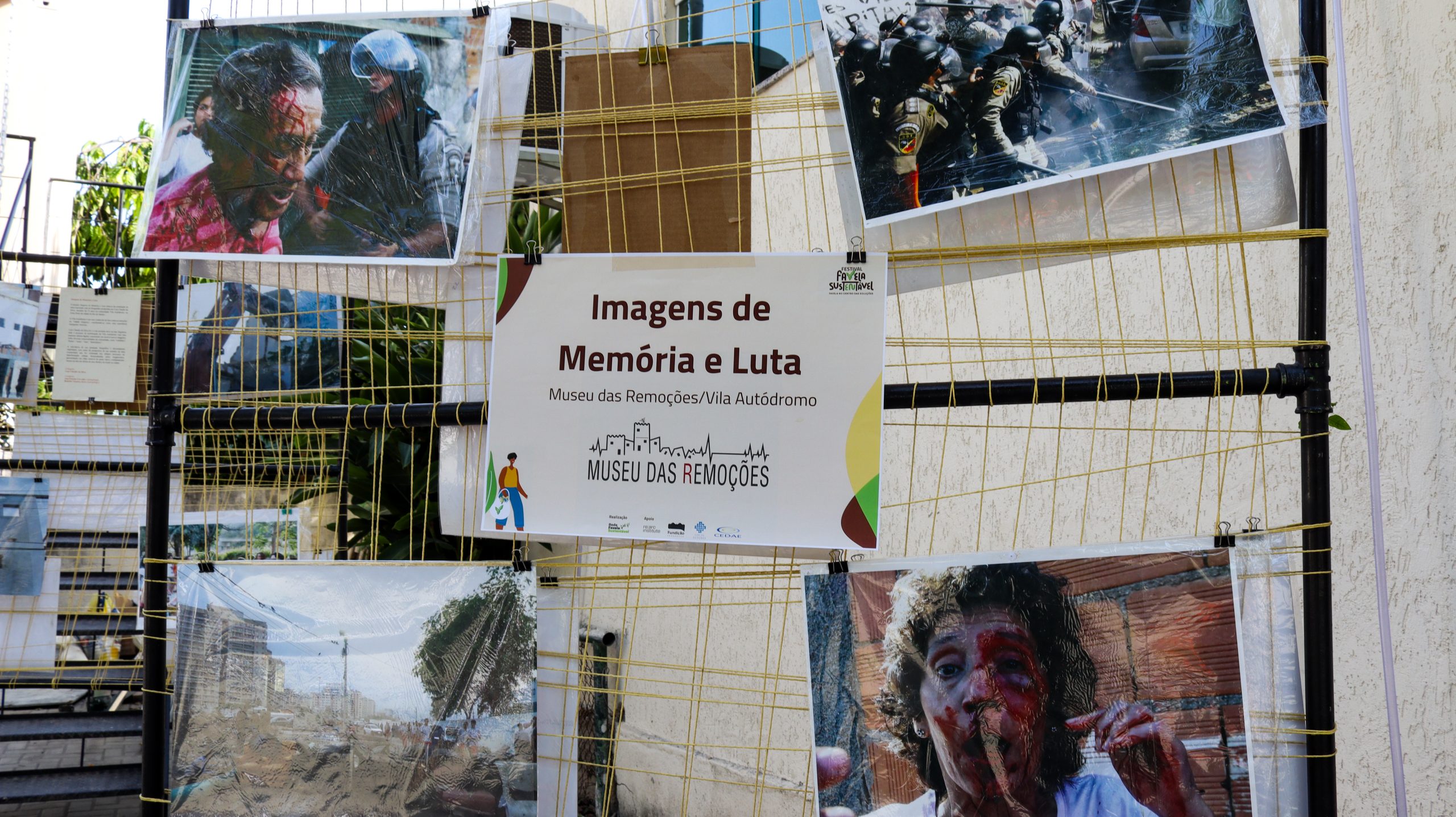
The forced evictions began in 2013 and intensified throughout 2014 and 2015, eventually concluding just months before the 2016 Olympics. The process transformed the community into a “war zone,” as described by resident Luiz Claudio da Silva, fraught with unrecognizable homes, broken pipes, no water, loose wires, and piles of rubble. Before the forced evictions, Vila Autódromo housed nearly 700 families, of which only 20 were able to remain. To preserve the memory of Vila Autódromo’s struggle as a counter narrative to the forced evictions perpetrated by the City, residents and supporters founded the Evictions Museum.
The date chosen for the inauguration of the Evictions Museum was far from arbitrary. On May 18, 2016, while the International Council of Museums (ICOM) promoted debates about “Museums and Cultural Landscapes,” the Evictions Museum emerged as an instrument of resistance, denouncing the region’s ongoing exclusionary and racist urban development project, which destroys cultural landscapes in the name of real estate speculation.
The Evictions Museum was founded on the belief that museums can and should play social roles that positively impact the preservation of landscapes and cultures, in addition to supporting communities. In Vila Autódromo, a community undergoing rapid transformation due to a forced eviction process, the Evictions Museum has served as a tool of resistance since its founding. For nine years, the institution has defended the motto: “memory cannot be evicted.”
Preserving and honoring the memories of places and people in Vila Autódromo, the Evictions Museum’s memory tour was first launched on September 23, 2018, as part of the 12th Museum Spring, promoted by the Brazilian Institute of Museums (IBRAM). The first version included 24 signs: 18 memorialization sites, four with street names, and two with explanatory texts. The 2025 newly inaugurated version now features 28 sites:
- Welcome to the Evictions Museum
- Community entrance plaque
- Resistance Crossing
- Church of Saint Joseph the Worker
- Ruins of Zezinho and Inês’s home
- Lamppost from Jaqueline’s home
- Ruins of Wilson and Iolanda’s home
- Residents’s Association
- Origin of the Evictions Museum
- Espaço Ocupa
- Ruins of Dona Denise’s home
- Site of Mateia’s former bakery
- Containers
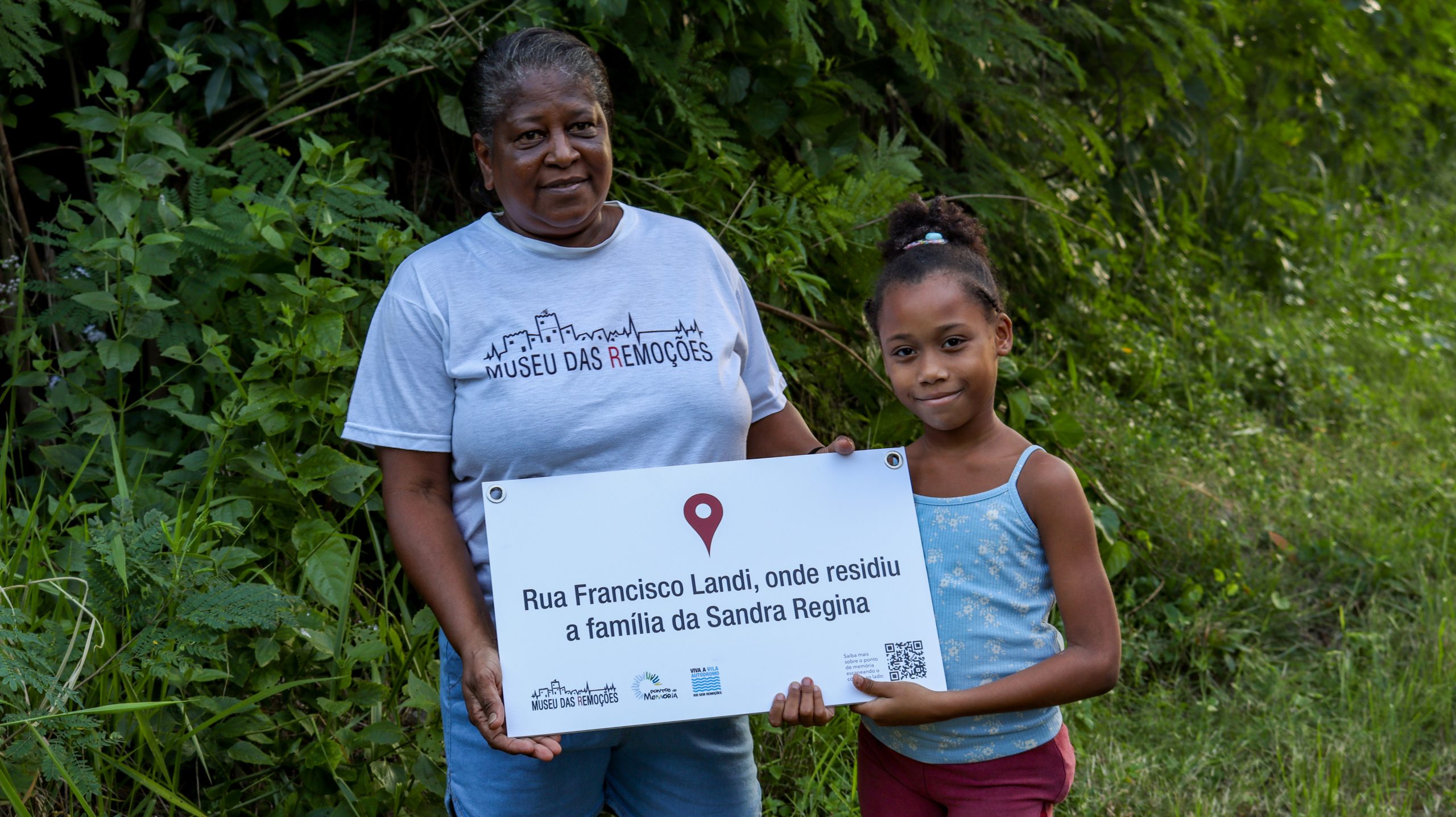
- Rua Francisco Landi – Home of Sandra Regina’s family
- Rua Gilles Villeneuve
- Dona Dalva lived on this street: she resisted and stayed
- End of Rua Beira Rio, where Iara and Gaúcho’s family lived
- AEIS (Special Area of Social Interest – Complementary Law 74/2005)
- Ruins of Seu Adão’s home
- Final barricades
- Children’s playground
- Legacy of the Future of Memory project
- Rua Vila Autódromo
- Capybara preservation plaque
- Animals also resisted forced evictions
- Ruins of an unidentified resident’s home
- Second stage of upgrades
- Replanting after the forced evictions
During this update, the exhibit gained four new memorialization sites: (1) Ruins of an unidentified resident’s home; (2) Animals also resisted the forced evictions; (3) Second stage of upgrades; and (4) Replanting after the forced evictions. In this new version, the exhibit uses more durable materials and includes accessibility features. Each plaque now displays a QR code linking to videos that explain the history behind each memorialization site, with captions in Portuguese, audio description, and Brazilian Sign Language. The work of updating and improving the exhibit was made possible thanks to the 2023 Sites of Memory Award, promoted by IBRAM.
The new memory tour was led by Luiz Claudio da Silva, Maria da Penha Macena, Nathalia Macena, and Sandra Maria Teixeira, remaining residents of Vila Autódromo and cofounders of the Evictions Museum. Along the way, some participants were invited to share memories related to the historical markers featured in the exhibit and to help install the new plaques.
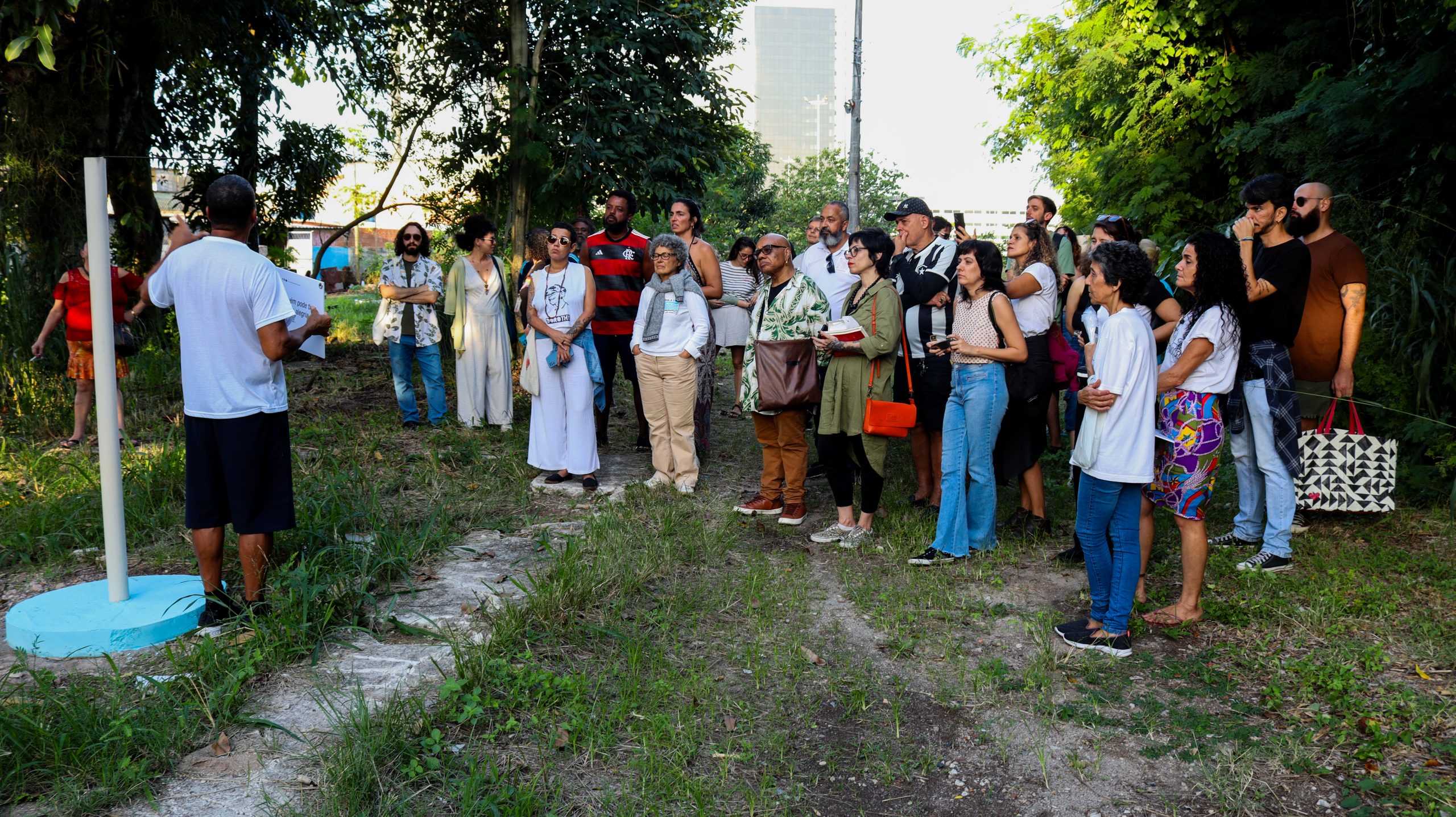
Among those present were current and former residents of Vila Autódromo, as well as supporters who took part in the community’s struggle at different moments. At the memorialization site honoring the ruins of Zezinho and Inês’s home, teacher Inalva Mendes Brito, a former resident of Vila Autódromo, shared her feelings about being forcibly evicted from her home.
“Zezinho and Inês’s home represents my own, which had no rights whatsoever—not even to a plaque. It was held as a [real estate] market reserve… So, their plaque and this space represent my feelings.” – Inalva Mendes Brito
Seu Wilson Menegoy, another former resident, who has a site of memory honoring the home he shared with Dona Iolanda, recalls how Vila Autódromo took him in. It was where he found stability and true happiness before being forcibly evicted and having his home demolished.
“I spent my whole life paying rent. Through some friends of my wife who lived in the community, I started visiting and grew to like the place. Then this piece of land became available, we managed to buy it, and built our house here in 1998. When we moved in, it was practically just the bare structure, and we slowly started plastering and finishing the place… We stayed here for 17 years, until the forced evictions. It was a very good period in our lives.” — Wilson Menegoy
One of the new sites celebrates the delivery of the community’s second stage of upgrading. The construction of the facilities was a demand made by residents who resisted forced eviction during negotiations with City Hall. Even so, the agreement only began to be fulfilled after renewed demands by residents between June 2022 and July 2023. Some community spaces that existed in Vila Autódromo before the eviction process were rebuilt: a multi-sports court, playground and sociocultural space.
In July 2023, the ruins of another home were discovered on the site, becoming one of the exhibit’s new sites. Sandra Maria explained: “We understand that, as the floor of a home belonging to an unidentified resident, it represents all the homes that were removed—homes of so many people who were never identified.” For this reason, on the Evictions Museum’s first anniversary, a solid brick from the home of an unidentified resident was one of the community objects memorialized through its donation to the National Historical Museum in 2017.
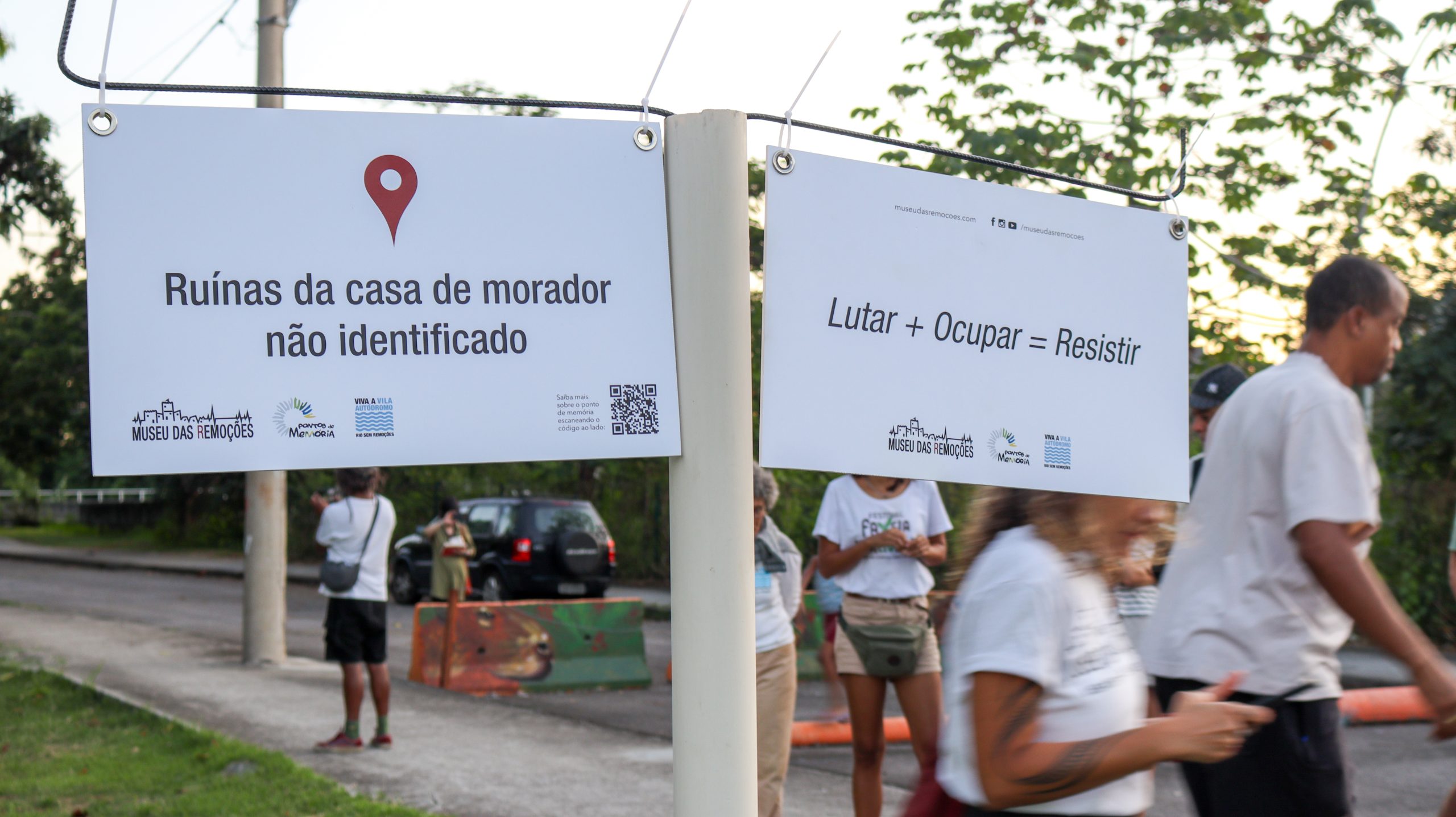
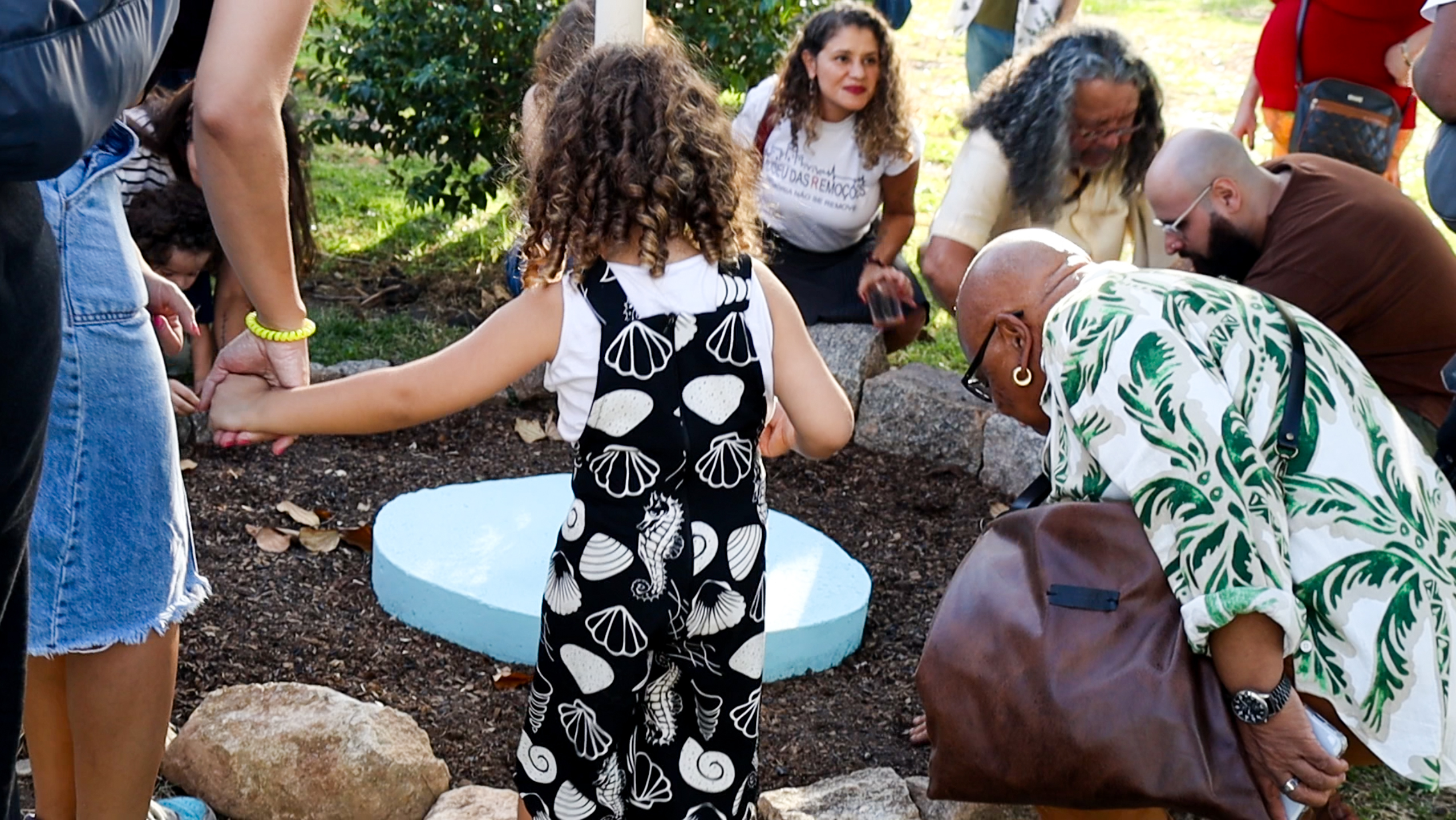
Another site of memory in the updated exhibit honors the animals of Vila Autódromo, recognizing that they, too, resisted the evictions. Nathalia Macena explained how the site was chosen.
“We understand that it’s not just us, human beings, who feel the impact of forced evictions. Pets, wild animals, and all other animals and living beings, in one way or another, to some degree, also suffer this impact. So we felt it was only fair to honor all animals, in general. Unfortunately, many people, unable to take their animals with them when they moved, left them behind. So many animals were abandoned. Those of us who stayed, fighting to remain in this community, were not only concerned with our own survival and subsistence, but also with the animals—because what they were going through wasn’t fair. It was inhumane.” — Nathalia Macena
Nathalia, visibly moved, shared that, near the new memorialization site, the body of little Nina is buried—a dog adopted by her family after being abandoned during the forced evictions of Vila Autódromo.
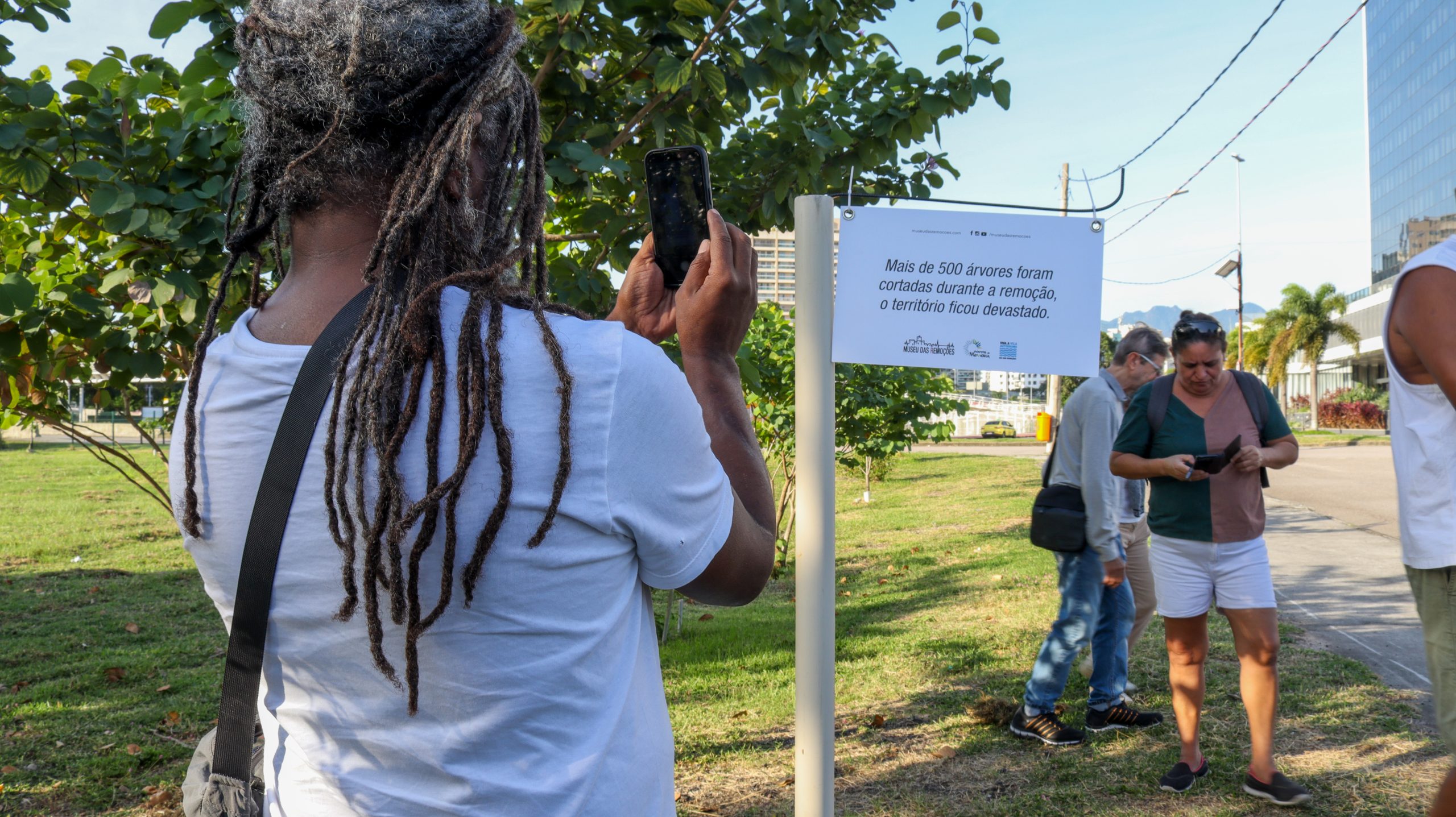
The forced evictions violently impacted the fauna, including human beings, but it’s also important to highlight that the flora—sometimes native vegetation—was also harmed and depleted during the removal of the community. Since the evictions, residents who resisted have been replanting, with seedlings in their backyards and through donations, in an effort to restore a key characteristic of Vila Autódromo before the removals: being a favela with many trees. Due to its importance, this community reforestation was also honored in the updated memory tour of the Evictions Museum.
“It was a hard moment, seeing those 30-meter-tall trees brought down. They would bring in the shredder, cut the branches, and beautiful trees were reduced to dust.” — Luiz Claudio da Silva
Afterwards, those present were invited to plant sunflower seeds around the memorialization site to support the community’s replanting efforts.
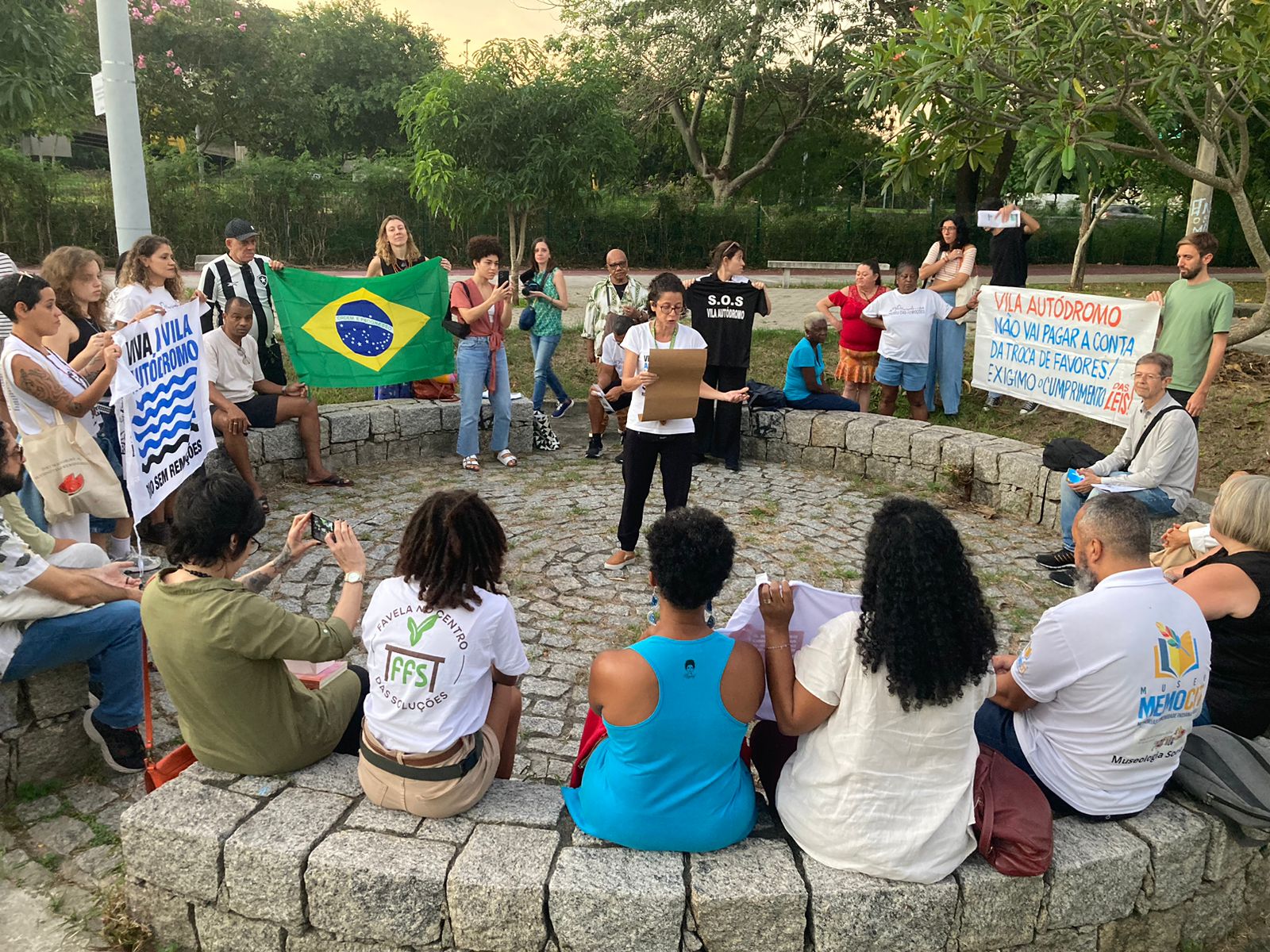
At the site “Legacy of the Future of Memory Project,” an initiative developed in partnership with the Goethe Institute, Nathalia, Sandra, Penha, and Luiz staged a collaborative artistic intervention, with a text written by Nathalia Macena. One of the passages refers to the “guerrilla strategies employed by City Hall to carry out evictions” and the “guerrilla strategies employed by residents to defend themselves.”
“If there’s a beating, there’s a barricade; if there’s aggression, there’s a protest; if there’s destruction, there’s occupation; if there are trees being cut down, there are seeds being planted; if we fall amidst the rubble, we stand up, shake off the dust, lift our heads up high—and stumble upon yet another of many innovations. [That’s when] the Evictions Museum is born.” — Nathalia Macena
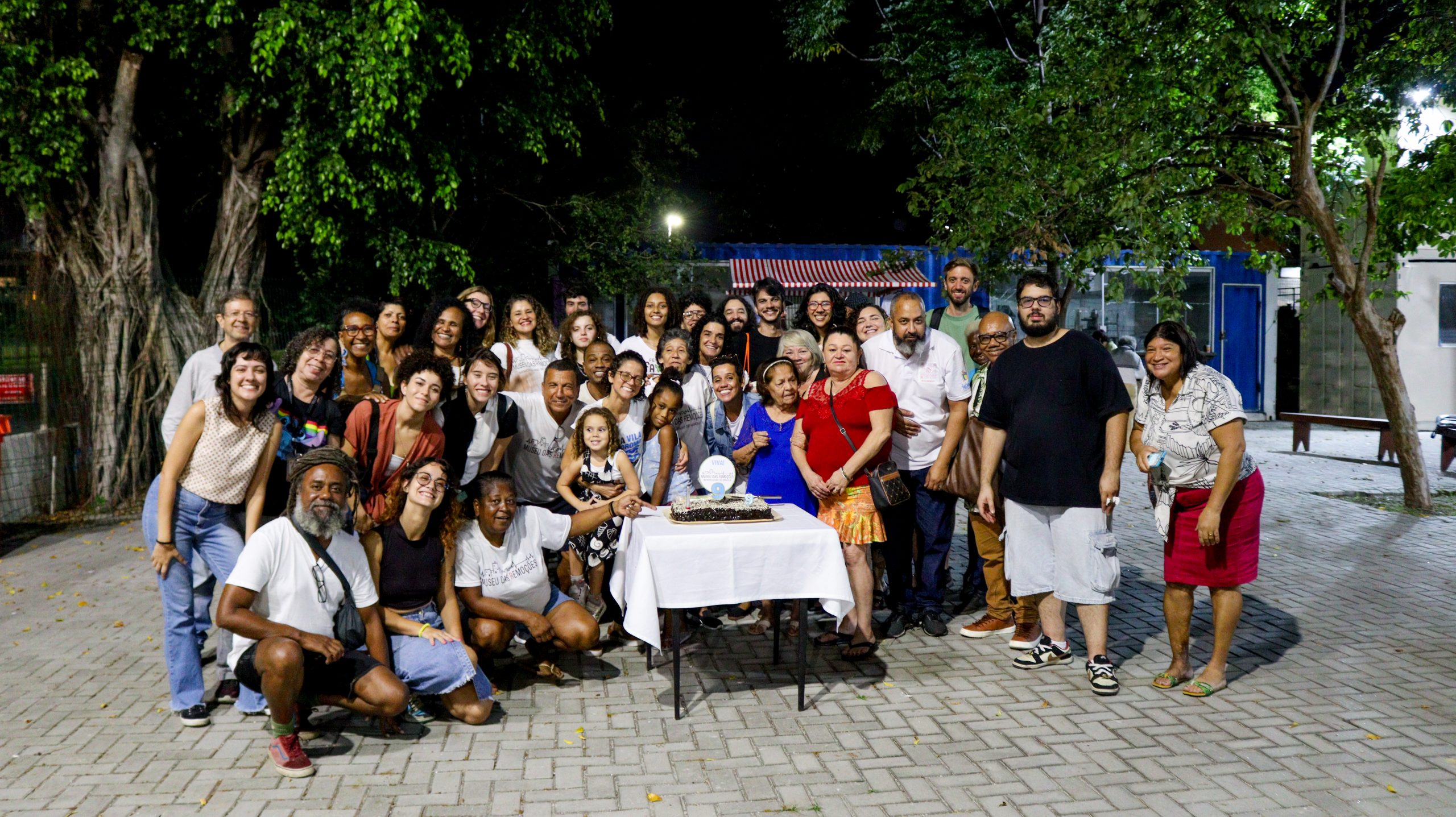
A birthday cake marked the end of the event, celebrating the Evictions Museum’s nine years of existence and resistance. Those present sang happy birthday to honor this nearly decade-long journey.
About the author: Lia Peixinho is a museologist (UNIRIO), holds a master’s degree in Museology and Heritage (PPG-PMUS – UNIRIO/MAST), is currently pursuing a bachelor’s degree in Anthropology (UFF) and a postgraduate degree in Cities, Urban Policies, and Social Movements (IPPUR/UFRJ). She is a member of the Evictions Museum’s management committee and works as a museologist at the Burle Marx Institute.